
A Year Later: Continuing Our Journey
It has been a little over a year since I wrote A Little Slice of Heaven — a reflection on place, family, and purpose. In this post, I share more...

By Ana Bendaña McEwan, General Manager, El Quetzal Estate · April 2026
It has been a little over a year since I wrote "A Little Slice of Heaven" in January 2025 — a reflection on place, family, and purpose. Looking back now, it feels like the right moment to pause and go a little deeper. El Quetzal is more than a coffee farm; it is a story shaped by land, legacy, and the people who have nurtured it across generations. In this post, I'd like to share more about where we are, how we came to be, and what continues to make El Quetzal so special.

Where We Are: El Quetzal's Location
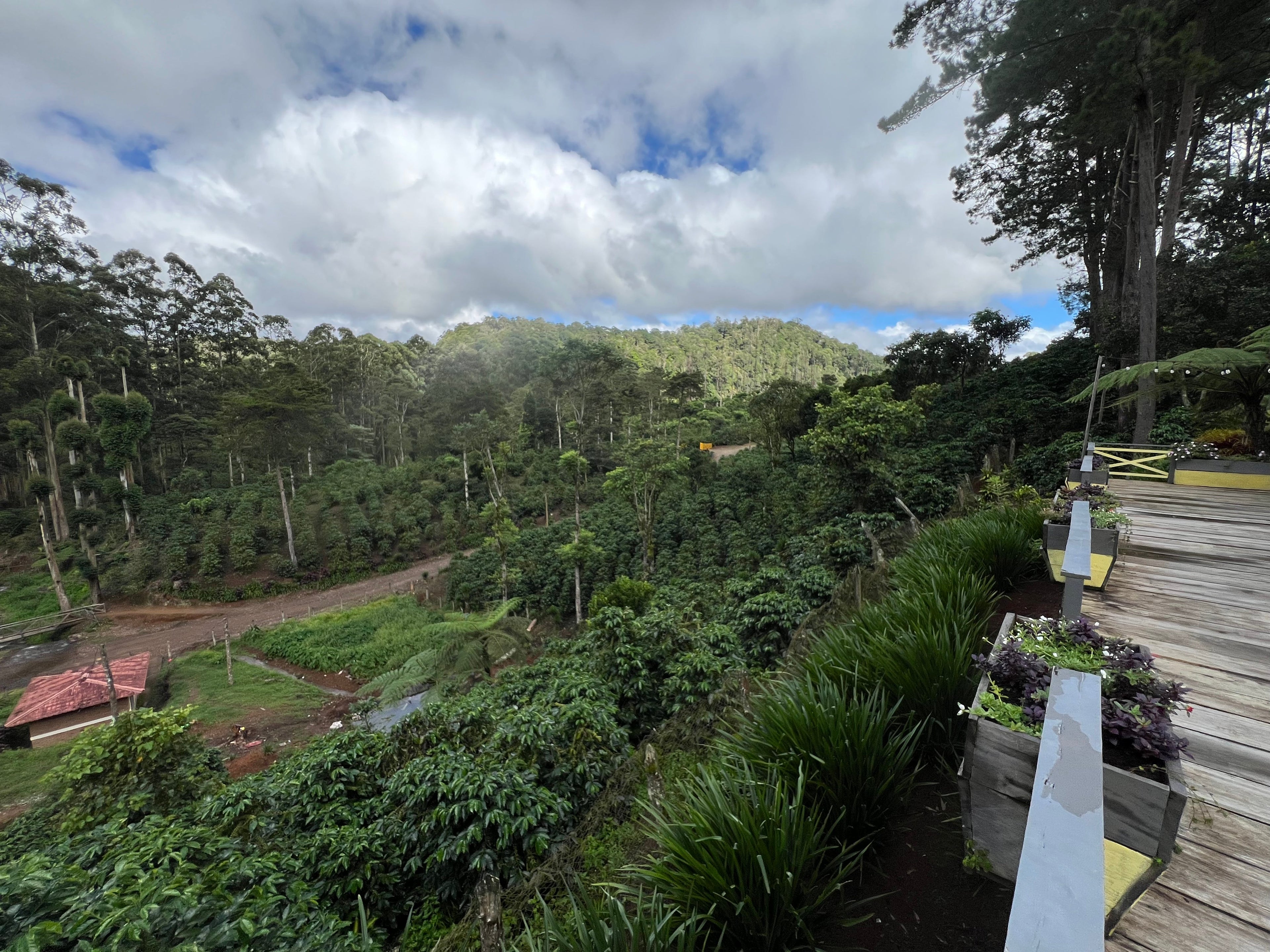
For those curious about our geographical roots, El Quetzal coffee farm is situated within El Arenal Natural Reserve — also known as Cerro El Arenal Natural Reserve — in the north central region of Nicaragua. This protected area covers 1,428 hectares (14.28 km²) in the Matagalpa department, nestled in the Cordillera Dariense mountain range. Our farm sits at approximately 13.05°N, 85.88°W in the heart of the cloud forest corridor. The reserve is composed entirely of private properties, with around 36 fincas (farms) dedicated to sustainable agroforestry practices.

El Quetzal Estate sits in the highlands north of Matagalpa. Coffee is transported south to Beneficio San Miguel for processing and export. Custom ArcGIS maps coming soon.
Our Neighbors and Natural Surroundings
For visitors who have traveled to Nicaragua, our eastern "neighbor" is the renowned Selva Negra Mountain Resort, set within the Selva Negra Cloud Forest Reserve — one of Nicaragua's 78 protected nature reserves. To the north lies the expansive Cerro Dantalí-El Diablo Natural Reserve, declared protected in 1991 and spanning 58 square kilometers. The indigenous name "Datanlí" is believed to derive from local indigenous languages, meaning "where the waters go down," highlighting the region's natural beauty and abundance. But El Quetzal's story is shaped not only by geography — it is rooted just as deeply in family.

How El Quetzal Became Part of Our Family
You now know where El Quetzal is located, but how did it become a part of the Bendaña McEwan family?
My first-generation Scottish Nicaraguan grandfather, Esteban McEwan, after completing his military service, purchased a small coffee farm called La Alianza. This allowed him to transition from military to farm work. As his family grew, so did his passion for farming, expanding his interests to cattle and citrus cultivation.

Family Roots and the Birth of El Quetzal
My father, Frank Bendaña Radzevich, was the first child born to a Nicaraguan father and a Lithuanian mother in New York, USA. He met my mother, Maria Teresa McEwan, at the Honduran Agricultural school of El Zamorano. They quickly fell in love and married within three months. Soon after, they returned to the US, where my father furthered his education at The University of Florida in Gainesville. He later earned a PhD in plant physiology and pursued post-doctoral research at Yale University. Upon returning to Nicaragua with my mother and three children, my grandfather — whom we affectionately called "Pa" — gave him part of his own farm, "El Paraíso." This gift marked the creation of El Quetzal, with my father transforming a beautiful mountain into the vibrant farm we know today.
Our Biodiversity and Cultural Heritage
As you can see, we are surrounded not only by rich biodiversity but also by a culturally and genetically diverse family. El Quetzal farm is home to over 200 bird species, both residents and migratory. Our farm's name is inspired by one of its endangered and vividly colored birds, the Quetzal.

These birds inhabit forests, especially humid highlands. The genus Pharomachrus consists of five exclusively Neotropical species, while the eared quetzal (Euptilotis neoxenus) is found in our country and the Resplendent Quetzal is also the national bird of Guatemala.
The average temperature in our mountains is 22°C (72°F) with year-long temperatures ranging between 15°C–28°C (58°–82°F). El Quetzal enjoys an overall perfect temperature. The warmest months are usually March to May, with highs reaching 28°C (82°F) and the coolest months are December to February, with lows around 15°C (58°F).
Nicaragua is still a hidden gem for birdwatching fans. Other bird species seen on our farm include the Turquoise-browed Motmot, called "guardabarranco" in Spanish (Eumomota superciliosa), which also happens to be Nicaragua's national bird, officially designated in 2012. Sitting atop a mountain and watching guardabarrancos fly free from tree-to-tree is truly an endearing experience.

You can also catch sight of the Montezuma Oropendola (Psarocolius montezuma) known simply as "oropéndola" in Nicaragua. The oropéndola builds hanging nests that can be three feet long. The nests hang like socks from the branches of trees. Other common sightings include the Three-wattled Bellbird (Procnias tricarunculata) — classified as Vulnerable by the IUCN, with males producing one of the loudest calls of any bird — and the Lovely Cotinga (Cotinga amabilis).

To recap, El Quetzal is nestled between protected reserves and high-altitude cloud forests, offering a rare combination of cool mountain air, rich biodiversity, and deep-rooted cultural heritage within the tropics. Surrounded by ancient forests and vibrant birdlife, our farm is both a sanctuary and a living landscape — one we are committed to protecting.
As we continue working towards producing exceptional specialty coffee, we remain equally dedicated to preserving our flora and fauna and strengthening our farm's path toward auto-sustainability, for the benefit of our workers, our neighbors, and future generations.
In my next blog, I'll share the progress we've made this year with the addition of vermiculture — the cultivation of earthworms — and aquaculture, our spring-water farming of tilapia along with the creation of our pre-secado area using artisanal African drying beds.
Until then, remember — life is too short for bad coffee.
— Ana Bendaña McEwan, El Quetzal Estate, April 2026
About the Author
Ana Bendaña McEwan (MSc, BHSc, RN) is the General Manager of El Quetzal Estate in Matagalpa, Nicaragua. Before returning to lead the family farm, she served nine years as a Peace Corps Medical Officer, three years as Executive Director of Operation Smile Nicaragua, and eight years in hospice and palliative care leadership in Texas. She is the eldest daughter of Dr. Frank Bendaña Radzevich (Don Paco) and represents the third generation of the Bendaña McEwan coffee family.
Photo Credits
Resplendent Quetzal: Frank Vassen, CC BY 2.0, via Wikimedia Commons
Turquoise-browed Motmot: Charles J. Sharp, CC BY-SA 4.0, via Wikimedia Commons
Three-wattled Bellbird: Dominic Sherony, CC BY-SA 2.0, via Wikimedia Commons
Farm photographs: El Quetzal Coffee Co.
References
Cerro Arenal Natural Reserve — Wikipedia (IUCN Category IV, WDPA ID 61054)
Datanlí-El Diablo Natural Reserve — Wikipedia
El Arenal on Protected Planet — UNEP World Conservation Monitoring Centre
Selva Negra Mountain Resort — Official Website
Escuela Agrícola Panamericana (El Zamorano) — Official Website
Resplendent Quetzal — Wikipedia (Near Threatened, IUCN)
Three-wattled Bellbird — Wikipedia (Vulnerable, IUCN)
Learn More About Our Family
The Bendaña McEwan family has been growing specialty coffee in Matagalpa since 1947. Read our story →


_(5818992683).jpg)